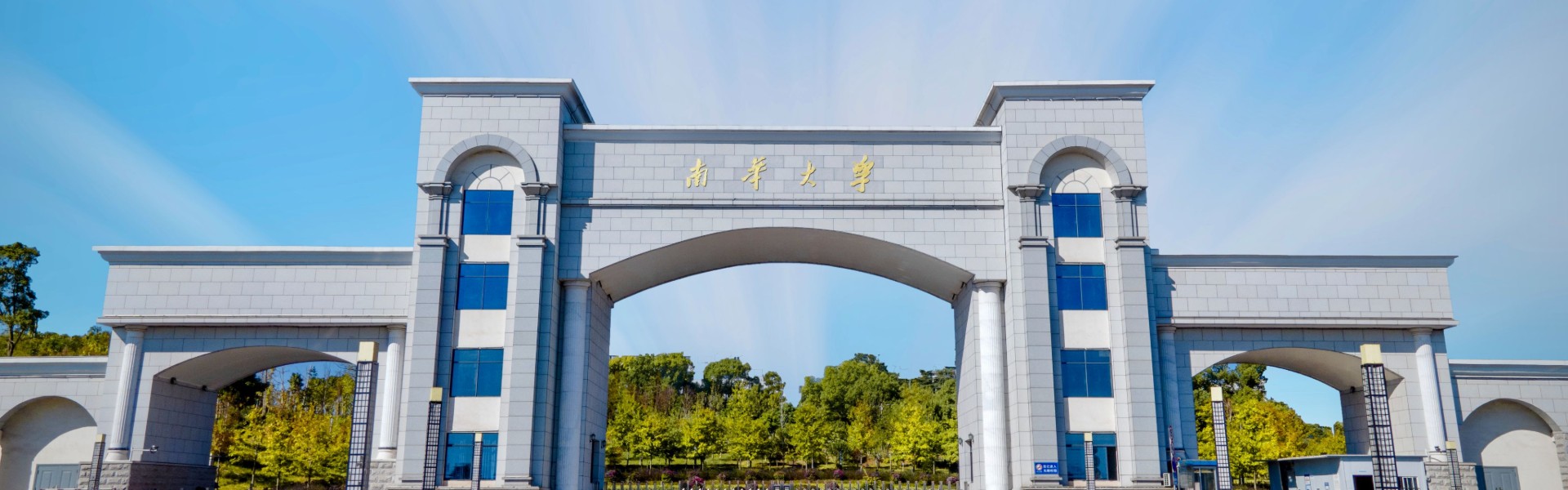
Recently, the 3rd International Conference on Big Data and Data Mining 2025 (shortened as "IEEE BDDM 2025"), jointly organized by IEEE China Federation, University of South China, and Central South University, with co-organization from Hunan Institute of Technology, ESBK International Academic Exchange Center, and AC Academic Platform, was held at the Hongxiang Campus of the University of South China. Focusing on cutting-edge technologies in big data analytics and data mining, the conference attracted experts and scholars from global universities, research institutions, and industries to Hengyang, where they engaged in exchanges and discussions on the deep integration of theoretical innovation and engineering applications, establishing a high-level international academic platform for interdisciplinary cross-innovation.
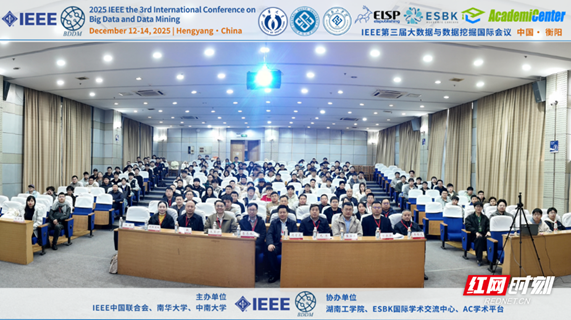
Group photo taken at the conference venue
At the opening ceremony, Professor Zhou Qingzhi, member of the Party Committee and Vice President of University of South China, delivered a speech. He pointed out that big data and data mining technologies are currently undergoing rapid development and widespread penetration, profoundly transforming scientific research paradigms and industrial economic structures. University of South China will continue to strengthen its academic positioning in cutting-edge areas such as data science and artificial intelligence, and actively foster an open and collaborative innovation ecosystem by hosting high-level international academic conferences.
Professor Long Jun, Chair of the Conference and Director of the Big Data Research Institute at Central South University, stated that this conference is not only an academic platform for showcasing the latest achievements and exchanging cutting-edge ideas, but also a crucial opportunity to promote deep integration among industry, academia, and research, and to facilitate the connection between innovation chains and industrial chains.
In the keynote presentation session, four experts provided in-depth analysis from a cutting-edge perspective on innovative breakthroughs and practical challenges of artificial intelligence and data science in critical fields such as management decision-making, healthcare, and time series forecasting.
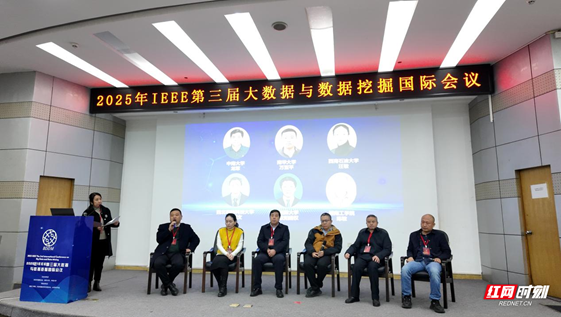
The main venue focuses on academic dialogue
The main venue also focused on academic dialogue, featuring a dedicated deans' forum. Experts gathered together to conduct in-depth discussions on three key topics: interdisciplinary integration as an enabler, guidelines for the application of AI tools in teaching and research, and collaborative efforts among universities in addressing global AI challenges, thereby consolidating industry consensus. In the parallel sessions, multiple scholars delivered detailed presentations and engaged in thorough discussions on critical issues and recent advancements within their respective fields.