Recently, a research team led by Professor Bi Lei from the University of South China, in collaboration with Professor Enrico Traversa of Sapienza University of Rome, Italy, published a cover article inEnergy & Environmental Science, a top international journal in the field of energy and environmental science with an impact factor of 30.5.The paper proposes a completely barium-free and cobalt-free inverted bilayer cathode structure, enabling proton-conducting solid oxide fuel cells to achieve a peak power density of 2,739 mW cm⁻² at 700 °C. This result sets a new performance record for Ba-/Co-free cathodes and surpasses most cathode materials containing barium or cobalt. Professor Bi Lei is the corresponding author, and the University of South China is the first and sole corresponding affiliation.
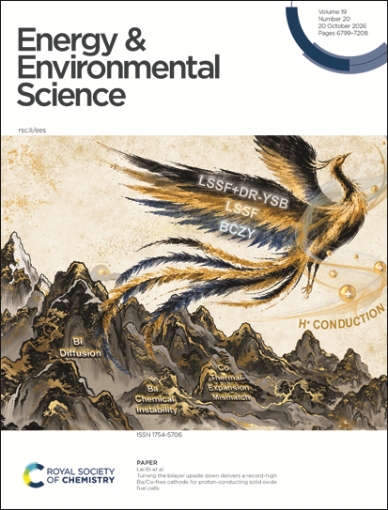
Proton-conducting solid oxide fuel cells are attractive for their high efficiency, clean operation, and relatively low operating temperature. However, sluggish cathode reaction kinetics have long limited their performance. Conventional high-performance cathodes often rely on barium and cobalt to enhance catalytic activity, but these elements can cause poor chemical stability and thermal expansion mismatch. To address this challenge, the team placed a single-phase LSSF layer in direct contact with the electrolyte and deposited an LSSF+YSB composite layer on top. This design avoids harmful reactions between YSB and the electrolyte while fully utilizing the high oxygen-ion conductivity of YSB. The team further prepared defect-rich YSB through ultrafast high-temperature sintering, thereby enhancing oxygen diffusion and surface exchange capability.
Tests showed that cells with the inverted bilayer cathode achieved peak power densities of 1,690, 2,206, and 2,739 mW cm⁻² at 600, 650, and 700 °C, respectively, along with excellent long-term stability and thermal cycling durability. The study breaks the long-standing performance bottleneck of Ba-/Co-free cathodes, provides a new strategy for designing high-performance and highly stable H-SOFC cathodes, and may also offer useful insights for other electrochemical devices facing interfacial compatibility challenges.