Recently, Professor Li Zhenye's team from the School of Mechanical Engineering of the University of South China published an important research result entitled "Spin-manipulation via novel MoPS3nanocrystal for high-performance thick-film organic solar cells" in Nature Communications. This study innovatively proposes an exciton dynamics optimization strategy based on spin regulation, which spontaneously3 forms a weak intrinsic magnetic field in the active layer and enhances the spin-orbit coupling through heavy atom effects, which significantly promotes the intersystem migration process of singlet excitons to long-lived triplet excitons, prolongs the exciton diffusion length, and inhibits non-radiative compound losses, and finally realizes a significant enhancement of the photovoltaic performance of thick-film organic solar cells. It has important scientific value for promoting the large-scale application of organic solar cells. Professor Li Zhenye is the first author and corresponding author of the paper, and the School of Mechanical Engineering of the University of South China is the first signatory of the paper.
The precise regulation of exciton dynamics in the active layer is the key to breaking through the bottleneck of thick film of organic solar cells and promoting their industrialization. However, the exciton diffusion length in the traditional thick film active layer is limited, and the singlet exciton is prone to non-radiative recombination before reaching the donor/acceptor interface, which seriously restricts the further improvement of device performance.
Based on this, Professor Li Zhenye's team innovatively proposed an exciton dynamics optimization strategy based on spin regulation, and developed a new two-dimensional ferromagnetic MoPS3 nanocrystal and incorporated it into the active layer as a multifunctional additive. MoPS3 nanocrystals can not only specifically coordinate with the donor/acceptor material to optimize the molecular stacking structure, but also introduce a weak intrinsic magnetic field into the active layer, enhance the spin-orbit coupling through the heavy atom effect, and significantly promote the interphylogenetic jumping process of singlet excitons to long-lived triplet excitons (Fig. 1). The incorporation of MoPS3 effectively narrows the singlet-triplet energy gap, extends the exciton diffusion length, and suppresses the non-radiative compound loss. After the MoPS3 nanocrystals were incorporated into the D18-Cl:L8-BO binary blending system, the devices formed a more orderly molecular stacking and a finer interpenetrating fiber network structure. MoPS3 can significantly reduce trap-assisted compounding and bimolecular recombination losses by extending the exciton diffusion length, improving charge mobility, and maintaining mobility balance, and finally realize the synergistic enhancement of key photovoltaic parameters of the device. Based on this strategy, the D18-Cl:L8-BO system achieved an efficiency of 20.37% at a thickness of 100 nm and a record efficiency of 19.36% (certified value of 19.13%) under a thick film of 300 nm. This strategy has also been successfully extended to other material systems, such as D18:L8-BO (100 nm/300 nm efficiency of 20.91%/19.63%) and PM6:Y6 (100 nm/300 nm efficiency of 19.13%/17.92%), demonstrating broad applicability and scalability. This strategy not only realizes the leapfrog improvement of the efficiency of multi-system organic solar cells, but also more effectively solves the industry pain points of thick film device efficiency attenuation, significantly enhances the industrial application potential of organic solar cells, and is of great significance for promoting the practical process of organic photovoltaic technology.
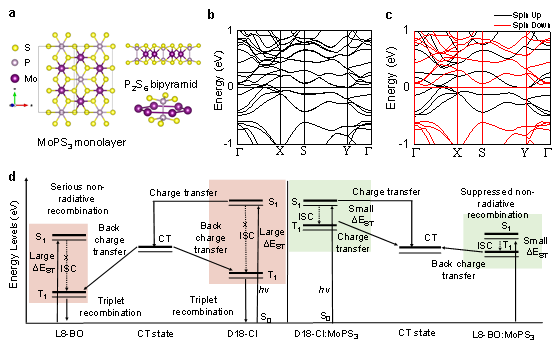
(a) the structure of the single-layer MoPS3; (b) Band structure diagram of MoPS3 with spin-orbit coupling and (c) without spin-orbit coupling; (d) Corresponding S1, T1, CT and charge transfer between D18-Cl and L8-BO and with and without MoPS3 nanocrystals
This study was jointly supported by the National Natural Science Foundation of China, the Natural Science Foundation of Hunan Province, and the Doctoral Start-up Fund of the University of South China.
Thesis connection: https://doi.org/10.1038/s41467-026-70320-7