Recently, two academic papers from Professor Wan Yaping’s team at the School of Computer Science and Technology, University of South China, have been accepted by UbiComp/IMWUT 2026. UbiComp is a Class A international conference recognized by the China Computer Federation (CCF) and one of the most influential top-tier venues in the field of ubiquitous computing. The two accepted works focus on human activity recognition using wearable devices and human pose reconstruction based on smart insoles, exploring innovative applications of artificial intelligence in intelligent sensing.
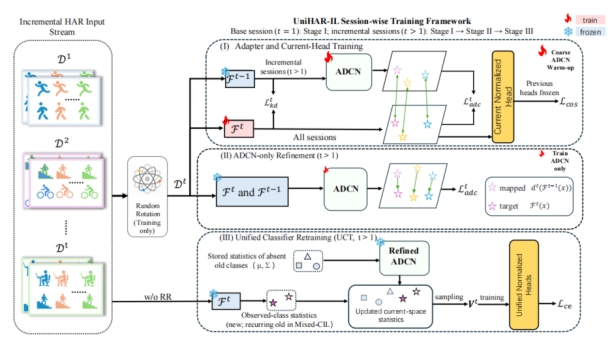
The first paper,UniHAR-IL: A Drift-Compensated Approach for Continuous Human Activity Recognition, was co-authored by Xiao Yang, Wu Yuanlong, Nie Mingxing, Zhu Tao, Wan Yaping, and others. In continuous learning scenarios where wearable devices are required to recognize newly added activity types, models often suffer from “catastrophic forgetting,” losing previously learned recognition capabilities. At the same time, shifts in device wearing orientation can further degrade recognition accuracy. To address these challenges, the team proposed a continuous learning method for human activity recognition that adapts to new activity categories while maintaining performance on previously learned ones and reducing interference caused by device orientation drift. The method demonstrated strong performance across multiple public datasets, offering a new solution for stable long-term human activity recognition in applications such as sports monitoring and smart healthcare.
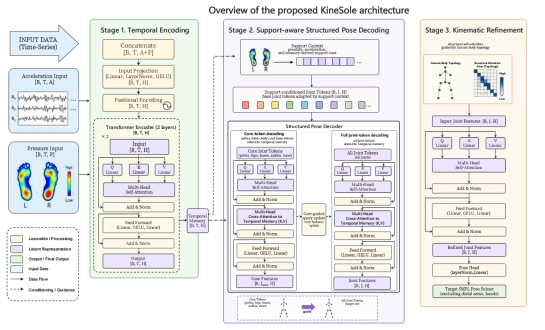
The second paper,KineSole: Human Pose Reconstruction from Sparse In-Shoe Sensors, was co-authored by Yu Liang, Zhu Tao, Lu Xiangqing, Liao Zhaoping, Qiu Qi, Chen Liming, Wan Yaping, and others. Traditional human pose capture systems often rely on a large number of sensors, resulting in high deployment costs and heavy wearing burdens. Taking a different approach, the team used commercial smart insoles to collect plantar pressure and acceleration signals, enabling inference of partial joint poses from sparse sensing data. The team also constructed and open-sourced the KineSTEP dataset, which includes more than 850,000 frames of synchronized sensor data collected from 20 participants across 38 activity scenarios. Experimental results show that the proposed model outperforms existing insole-based baselines in both pose reconstruction accuracy and temporal stability, providing an important reference for lightweight and low-burden human motion sensing.
These two achievements address two key challenges in wearable intelligent sensing: continuous learning and sparse sensing. They demonstrate the strong research capabilities of faculty and students at the School of Computer Science and Technology in the interdisciplinary area of artificial intelligence and ubiquitous computing, and mark important progress in the school’s efforts to strengthen disciplinary development and encourage frontier interdisciplinary research.