Recently, Associate Professor Tian Wenlong and Professor Wan Yaping's team from the School of Computer Science at University of South China, Teacher Wang Zhaohao from Huazhong University of Science and Technology, Teacher Lu Jianfeng from Wuhan University of Science and Technology, Teacher Weijun Xiao from Virginia Commonwealth University in the United States, and Teacher Zhiyong Xu from Suffolk University in the United States jointly published a latest research paper titled "Ripple Shapley: Data Influence Attribution in One Federated Training Run" at the top international academic conference AAAI (Annual AAAI Conference on Artificial Intelligence) in the field of artificial intelligence. This achievement takes University of South China as the first unit, with Zeng Dewen, a 2023 postgraduate student from the School of Computer Science at University of South China, as the first author and Teacher Tian Wenlong as the corresponding author. It was accepted as an Oral Presentation. AAAI is one of the oldest and most comprehensive top international academic conferences in the field of artificial intelligence. It has been rated as a Class A conference by the China Computer Federation and the Chinese Association for Artificial Intelligence, and has high authority in the academic evaluation system. The acceptance rate of this conference is only 17.6%. The AAAI 2026 conference will be held in Singapore from January 20 to 27, 2026.

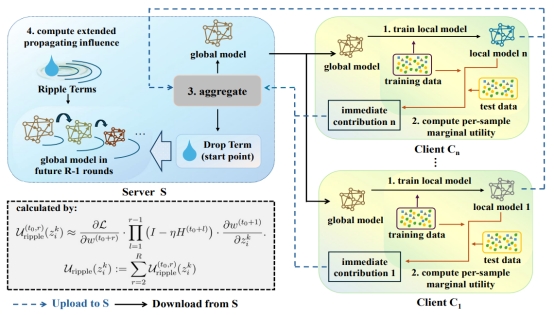
Data Attribution (Data Contribution Evaluation) is a core issue in the incentive mechanisms and trustworthy collaboration of federated learning. It aims to quantify the real impact of each participant or sample on the performance of the global model. Existing theoretical methods based on Shapley values often face high computational complexity and ignore the temporal propagation characteristics of data impact, thus failing to effectively reflect the true impact of samples. Our team has proposed a new framework called Ripple Shapley, which enables high-precision and low-overhead data value attribution during a single federated training process. This framework provides both theoretical breakthroughs and practical paths for long-term impact modeling in federated learning. For the first time, our team adopts a temporal propagation perspective, decomposing sample impact into the Drop term (which characterizes the immediate utility of a sample in the initial training round) and the Ripple term (which models how sample impact gradually diffuses through multiple rounds of global updates). This modeling reveals the recursive dependency structure of federated optimization and enables explicit tracking of cross-round impact paths, thereby extending the Shapley value from static fairness theory to dynamic impact attribution mechanisms.
In recent years, University of South China has adhered to the strategy of strengthening the university with talents, focused on cultivating academic talents, and attached great importance to the development of the computer discipline. It has revised the scientific research discipline evaluation and talent incentive policies, providing a solid policy foundation for the continuous breakthroughs in scientific research achievements in the field of artificial intelligence at the university. This breakthrough marks that the School of Computer Science of University of South China has taken a solid step in its "dual-wheel drive" strategy of high-quality scientific research and cultivating top-notch innovative talents, contributing to the university's "Double First-Class" construction.